AI Code Assistants Speed Typing, Not Delivery by Default
July 29, 2026 · 7 min read
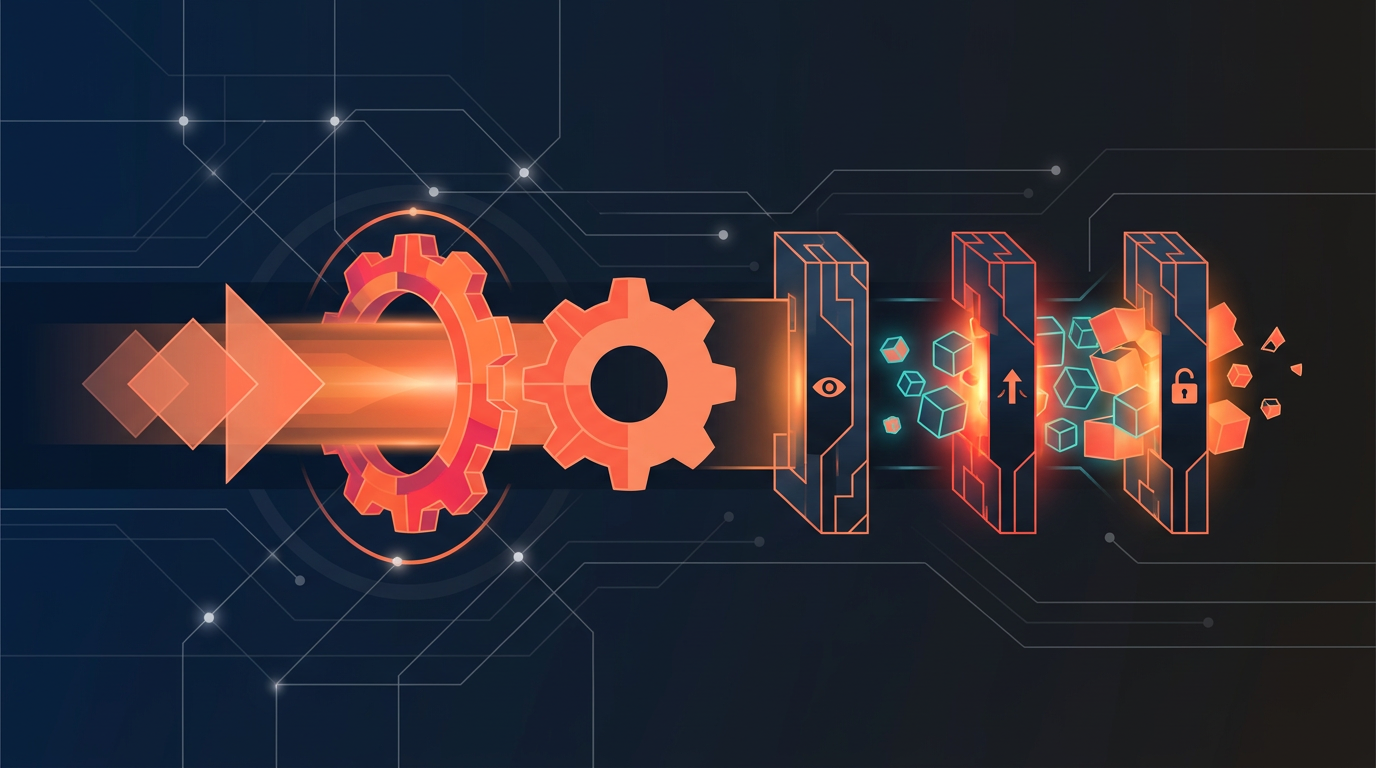
AI code assistants are now good enough to change everyday software development. They complete routine code, draft tests, explain unfamiliar modules, generate migrations, and help engineers navigate APIs without leaving the editor.
That does not mean they automatically improve delivery velocity.
Typing code is only one part of the path from idea to production. Most organizations are constrained by unclear requirements, architectural dependencies, slow reviews, unstable environments, manual testing, security gates, or release coordination. Making implementation faster can improve the system—or simply move the queue downstream.
Engineering leaders should evaluate assistants as a change to the delivery system, not as an individual productivity perk.
The wrong question is how much code gets generated
Vendor studies often emphasize acceptance rates, task completion time, or developer satisfaction. These are useful signals, but they do not establish business impact.
Lines of code are especially misleading. More code can mean more maintenance, larger pull requests, and more opportunities for defects. An assistant that generates a 300-line abstraction may look productive while a senior engineer would have solved the problem with a small configuration change.
The relevant question is: does the team deliver valuable, reliable changes faster?
That requires measuring outcomes across the full workflow:
- Lead time from work started to production
- Cycle time from first commit to deployment
- Pull request review time and number of review rounds
- Deployment frequency
- Change failure and rollback rates
- Escaped defects and production incidents
- Rework performed shortly after merge
- Developer time spent waiting, debugging, and coordinating
An assistant may reduce implementation time by 25% while leaving lead time unchanged because review and validation absorb the savings. That is still useful information. It reveals where the actual constraint sits.
Where assistants create real leverage
The strongest use cases have bounded scope, rapid feedback, and clear correctness criteria.
Boilerplate is an obvious example. Assistants are effective at generating API clients, data transfer objects, test fixtures, repetitive mappings, documentation scaffolds, and standard infrastructure definitions. Engineers can verify these outputs quickly because the patterns are already understood.
They also help with unfamiliar codebases. Asking for a summary of a module, likely call paths, or an explanation of a failing test can reduce navigation time. This is particularly valuable during onboarding, incident response, and work across team boundaries.
Test creation can provide leverage when engineers specify the intended behavior rather than asking for superficial coverage. Assistants can enumerate edge cases, create parameterized cases, and draft regression tests from a known defect. The engineer must still confirm that the tests assert business behavior instead of reproducing the implementation.
Small refactors are another good fit. Renaming interfaces, converting repetitive constructs, updating deprecated APIs, or adding instrumentation can be accelerated when automated tests and static analysis provide tight feedback.
These tasks share one property: generated work is cheap to inspect and cheap to reject.
Where velocity gains disappear
AI-generated code is inexpensive to produce but not free to understand. That shifts effort from writing toward reviewing, testing, and maintaining.
Large generated pull requests are a common failure mode. The author moves quickly, but reviewers must reconstruct the intent, distinguish necessary changes from incidental ones, and identify assumptions the assistant made. Review latency rises, and shallow approvals become more likely.
Rework is another hidden cost. Assistants can generate locally plausible solutions that violate repository conventions, duplicate existing capabilities, mishandle edge cases, or introduce dependencies the team does not want. The code may compile and pass a narrow test suite while still being wrong for the system.
Junior engineers are particularly exposed. An assistant can help them complete unfamiliar tasks, but it can also let them produce code they cannot explain. That creates a delayed cost for senior reviewers and weakens learning if generated answers replace investigation.
Assistants also encourage scope expansion. Once code becomes easier to generate, teams may add abstractions, tests, documentation, or refactors that were not required for the change. Some additions are valuable. Others increase batch size and review burden without improving the outcome.
The practical rule is simple: generation should not outpace the team’s ability to validate.
Treat adoption as a workflow experiment
Do not roll out licenses and declare success based on usage. Start with an explicit hypothesis.
For example: “Using an assistant for routine service changes will reduce median cycle time by 15% without increasing review rounds or change failures.” This creates a measurable claim and names the guardrails.
Choose two or three teams with comparable work and establish a baseline over several weeks. Segment the data by work type. A production defect, dependency upgrade, greenfield endpoint, and cross-service feature have very different delivery profiles. Combining them hides the effect.
During the trial, capture both system metrics and qualitative evidence. Ask engineers where the tool saved time, where it generated rework, and which tasks they stopped delegating to it. Ask reviewers whether pull requests became easier or harder to evaluate.
Avoid measuring individual developers against one another. Tool telemetry is noisy, work complexity differs, and surveillance will distort behavior. The objective is to improve team throughput and reliability, not reward the highest suggestion acceptance rate.
After the trial, compare distributions rather than averages. Median cycle time can improve while the slowest changes become much worse. Pay attention to the 75th and 90th percentiles, where dependencies, review queues, and rework usually appear.
Put guardrails close to the generated code
Policy documents are not enough. The safest controls are automated and immediate.
Teams adopting assistants should strengthen:
- Fast unit and integration test feedback
- Formatting, linting, type checking, and static analysis
- Dependency and secret scanning
- Pull request size limits or review guidance
- Clear ownership and architecture boundaries
- Repository-level instructions for conventions and prohibited patterns
- Requirements that authors can explain and support submitted code
Keep pull requests small. A useful assistant workflow is to generate one bounded change, run validation, inspect the diff, and commit before moving on. This preserves reviewer comprehension and makes regressions easier to isolate.
Sensitive code needs stricter rules. Authentication, authorization, billing, cryptography, data deletion, and concurrency logic deserve experienced review regardless of how the code was produced. Some tasks should require threat modeling or dedicated test evidence before merge.
Licensing and data handling also matter. Leaders should know whether prompts or repository content are retained, used for training, or sent across regions; how access is controlled; and whether generated code creates intellectual-property concerns. These are procurement and security questions, not decisions to leave to individual developers.
Faster coding may expose a different bottleneck
If implementation time falls, review may become the constraint. If review improves, test environments may become the constraint. If deployment becomes easy, product decision latency may dominate.
This is expected. Delivery is a system of queues.
Leaders should use assistant adoption to examine the entire value stream. Map the time a representative change spends being implemented, waiting for review, under validation, blocked by dependencies, and awaiting release. Then invest where work waits longest.
That may mean adding reviewers, improving test reliability, reducing service coupling, clarifying acceptance criteria, or moving from scheduled releases to continuous delivery. An AI tool cannot compensate for a workflow that regularly holds completed changes for a week.
The largest gains often come when assistants are paired with these engineering improvements. Faster implementation plus smaller batches, dependable automation, and rapid deployment can materially increase throughput. Faster implementation inside a slow approval process cannot.
Takeaway
AI code assistants are useful accelerators for bounded, verifiable work. Their impact should be judged by lead time, review effort, rework, and production quality—not generated code or developer activity.
Start with a measured trial, keep changes small, automate validation, and watch where the queue moves. The goal is not to help engineers type faster. It is to help the organization deliver reliable software sooner.