Give Engineering Agents Bounded Ownership in Production
August 25, 2026 · 7 min read
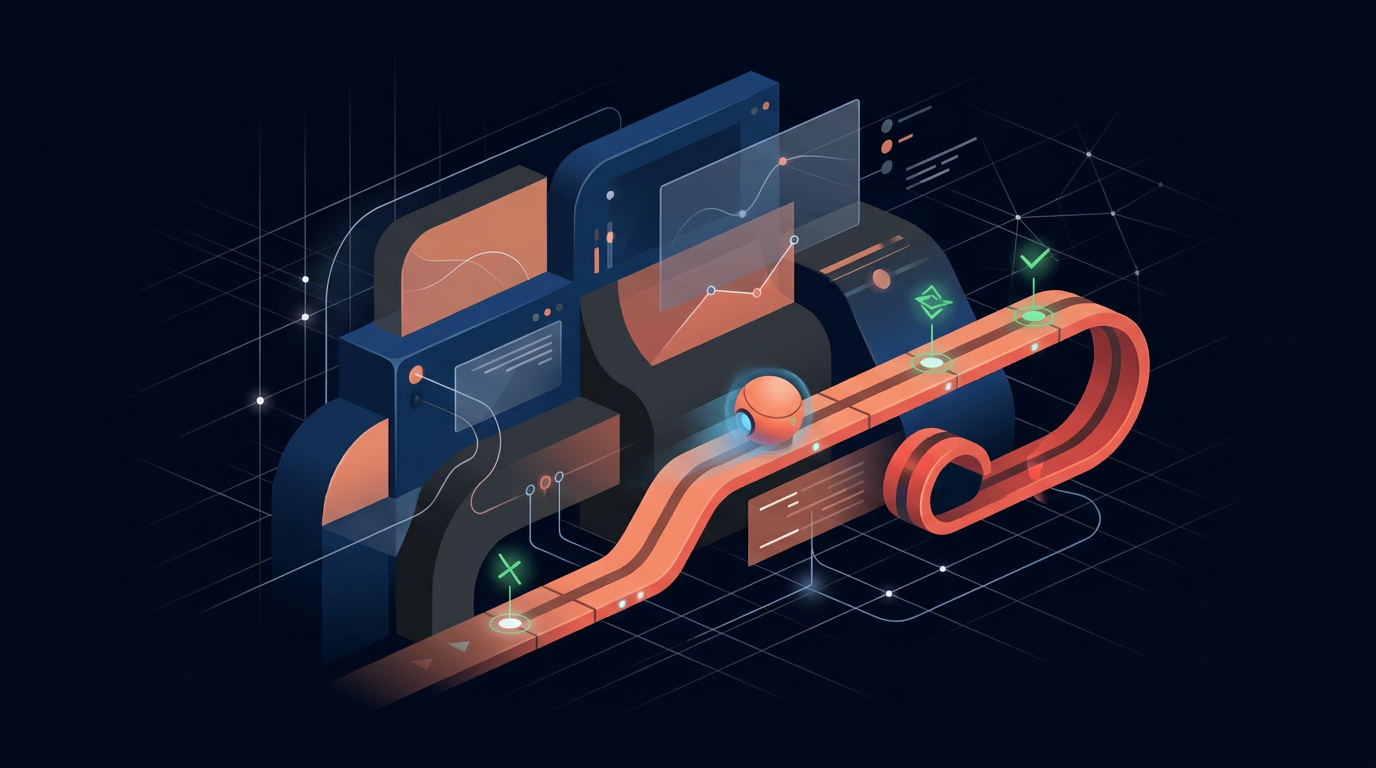
Agentic AI is moving from coding assistants into the engineering system itself. Agents can investigate incidents, prepare dependency upgrades, classify flaky tests, update infrastructure, and propose operational changes.
The difficult question is no longer whether an agent can complete a task in a demonstration. It is whether an engineering organization can safely give software enough authority to act across repositories, CI pipelines, cloud accounts, ticketing systems, and production services.
The practical answer is bounded ownership: assign an agent a durable but narrow responsibility, then constrain how it observes, decides, and acts. This is a better production model than either extreme—an unrestricted autonomous engineer or a passive chatbot that never changes anything.
Start with responsibilities, not agent capabilities
Teams often begin by listing what a model can do: call tools, read logs, write code, browse documentation, or coordinate subtasks. That produces impressive prototypes but weak operating models.
Start instead with an engineering responsibility that already has a clear owner and outcome. Good candidates have frequent demand, repeatable decision criteria, and reversible actions.
Examples include:
- Keeping approved dependencies within one minor version of the current release
- Identifying and quarantining tests that meet a documented flakiness threshold
- Producing first-pass incident timelines from logs and deployment events
- Detecting expired feature flags and opening removal pull requests
- Scaling non-production environments within fixed cost and capacity limits
- Applying low-risk configuration remediations covered by an existing runbook
“Help with incidents” is too broad. “Collect evidence and draft a timeline for HTTP error-rate alerts” is an assignable responsibility. The narrower definition makes permissions, evaluation, and escalation concrete.
Each responsibility should have a named human owner. The agent may perform the work, but a team remains accountable for its policy, tools, and outcomes.
Define an autonomy contract
Before connecting an agent to operational tools, write an autonomy contract. This is a machine-enforced specification of what the agent may do without approval, what requires review, and what is prohibited.
A useful contract covers five areas:
- Scope: repositories, services, environments, ticket queues, and resource types the agent may access.
- Actions: read-only operations, proposed changes, automatically executed changes, and forbidden operations.
- Budgets: limits on tokens, tool calls, elapsed time, cloud spend, retries, and changed files or resources.
- Approval rules: conditions requiring a specific role, not merely any available user.
- Recovery: rollback commands, transaction boundaries, timeout behavior, and the owner paged after failure.
Do not leave these constraints inside the system prompt. Prompts guide behavior; they do not enforce authority. Permissions belong in identity policies, tool wrappers, CI rules, and deployment controls.
Use a distinct workload identity for each agent responsibility. Avoid shared service accounts. Short-lived credentials, narrowly scoped roles, and complete action logs make it possible to revoke one workflow without disabling the whole platform.
Separate planning from execution
An agent should not receive a shell, a cloud administrator role, and an instruction to “fix the problem.” That interface turns model uncertainty into infrastructure risk.
Separate the system into a planner and a controlled execution layer. The planner interprets context and proposes typed actions. The execution layer validates those actions against deterministic policy before calling a tool.
For example, an infrastructure agent might propose:
{
  "action": "restart_deployment",
  "cluster": "prod-eu-1",
  "namespace": "payments",
  "deployment": "settlement-worker",
  "reason": "health checks failed after rollout",
  "evidence_ids": ["alert-4821", "deploy-9914"]
}
The executor can reject unknown clusters, protected workloads, missing evidence, excessive restart frequency, or actions outside an incident window. This validation should be ordinary code with tests—not another model deciding whether the first model behaved correctly.
Prefer small, purpose-built tools over general terminal access. get_deployment_status and restart_deployment expose less risk than arbitrary kubectl. Parameter schemas also improve auditability and reduce errors caused by generated command syntax.
Use progressive authority
Production autonomy should be earned with evidence. Roll out an agent through explicit authority levels:
- Observe: gather data and record what it would do.
- Recommend: produce a proposed action and rationale for human review.
- Execute with approval: prepare the change, then wait for an authorized decision.
- Execute within bounds: act automatically only for approved cases.
- Handle exceptions: escalate anything outside policy rather than improvising.
Do not promote an agent because its recommendations “look good.” Set thresholds before the trial. Track proposal acceptance, incorrect-action rate, unnecessary escalations, recovery success, and time saved for the owning team.
Include negative cases. An agent ready to restart a failed development workload may still be unsafe when a production deployment is mid-migration, an incident commander has frozen changes, or telemetry is incomplete.
Promotion should be scoped. An agent can have automatic authority in staging while remaining recommendation-only in production. It can update patch versions automatically but require approval for major upgrades.
Design for interruption and partial failure
Agent workflows are long-running distributed systems. Models time out. Tool calls succeed without responses. Approvals arrive late. A deployment completes while the agent is retrying. The same event may be delivered twice.
Every consequential action therefore needs an idempotency key and a recorded state transition. A practical state model might include requested, validated, approved, executing, verified, rolled_back, and escalated.
Persist state outside the model context. After a crash, the workflow should resume from verified facts rather than asking the model to reconstruct history from a transcript.
Verification also matters. A successful API response does not prove the intended outcome occurred. After changing a configuration, the agent should check deployment status, relevant health indicators, and policy-specific acceptance conditions. If verification fails, it should roll back or escalate according to the contract.
Set a maximum number of reasoning and execution cycles. An agent repeatedly trying alternate fixes is not resilient; it is an uncontrolled change process.
Put agents inside existing engineering governance
Agents should use the same systems of record as engineers. Code changes belong in pull requests. Infrastructure changes belong in deployment pipelines. Incident actions belong in the incident timeline. Exceptions belong in tickets with an owner and deadline.
Avoid creating an “agent lane” that bypasses branch protections, separation of duties, maintenance windows, or change records. Automation is a reason to make governance executable, not to remove it.
Agent output should clearly identify:
- The workload identity that initiated the action
- The policy and version that authorized it
- The evidence used in the decision
- Any human approval and approver role
- Tool calls and resulting state changes
- Verification and rollback outcomes
This record supports debugging, compliance, and post-incident review. More importantly, it lets teams improve the system based on actual failure modes rather than prompt anecdotes.
Operate the agent as a production service
An agent needs an owner, an on-call path, versioned releases, and service objectives. Measure operational behavior, not conversational quality.
Useful indicators include action completion rate, policy rejection rate, approval latency, duplicate-action prevention, mean time to escalation, rollback frequency, and cost per completed responsibility. Segment results by action type and environment; aggregate success rates conceal risky edge cases.
Run periodic access reviews. Responsibilities change, repositories move, and temporary permissions become permanent unless someone removes them. Test kill switches and credential revocation during routine exercises, not during the first real incident.
Finally, budget for maintenance. Tool APIs, operational policies, and service architectures change. An agent connected to stale runbooks or deprecated endpoints can remain confidently wrong long after launch.
Takeaway
Production engineering agents should own narrow responsibilities, not vague goals. Give them typed tools, enforceable authority limits, persistent workflow state, staged autonomy, and deterministic rollback paths. The objective is not maximum autonomy. It is dependable engineering capacity that the organization can inspect, interrupt, and trust.