Reliable Multi-Agent Systems Need Explicit Control
July 28, 2026 · 7 min read
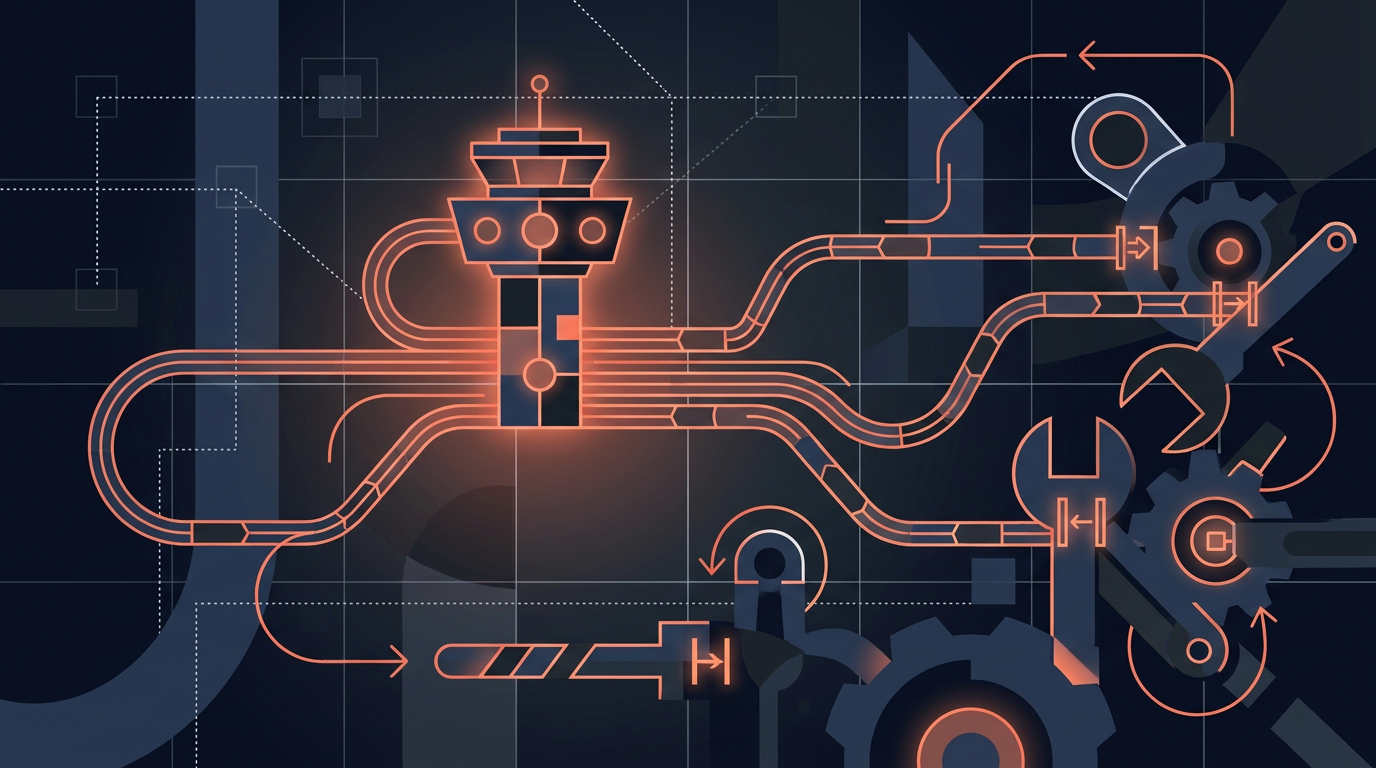
Multi-agent systems are often presented as teams of autonomous specialists that negotiate, delegate, and solve problems together. That framing is useful for demos. It is dangerous as an engineering model.
In production, an agent is better understood as a bounded decision component: a model invocation with defined context, permitted tools, an output contract, and a failure policy. Multi-agent orchestration is the control plane that decides which component runs, what it can access, and what happens next.
The hard part is not making agents communicate. It is preventing ambiguous ownership, unbounded loops, duplicate side effects, and invisible failures.
Start with a workflow, not a cast of characters
Before creating a “researcher,” “planner,” and “reviewer,” map the actual workflow. Identify decisions, deterministic operations, external side effects, and points that require human judgment.
Use normal code for predictable transformations. Reserve model calls for tasks with genuine semantic uncertainty, such as classifying an unusual support request or synthesizing evidence from several documents.
A useful agent boundary has:
- One clear responsibility
- A constrained context window
- An explicit input and output schema
- A small allowlist of tools
- A completion condition
- A timeout, retry policy, and escalation path
If two agents need the same context, tools, and success criteria, they may not be separate agents. Splitting them can add latency and failure modes without adding useful specialization.
Choose the simplest orchestration pattern that fits
Most production systems need one of four patterns. They can be combined, but each additional pattern raises the operational cost.
Router and specialists
A router classifies an incoming request and sends it to a specialized agent. A service desk might route requests to billing, account access, or technical support agents.
This pattern works when categories are reasonably stable and specialists need different tools or policies. The router should return a structured route and confidence score, not prose. Low-confidence or high-risk cases should fall back to a general workflow or human queue.
Do not let the router solve the request while routing it. That creates duplicated reasoning and makes ownership unclear.
Supervisor and workers
A supervisor decomposes a goal, assigns tasks to workers, and combines their outputs. This is appropriate for work that can be divided into distinct streams, such as reviewing architecture, security, and operational readiness for a proposed design.
The supervisor should own the plan and final state. Workers should not freely create more workers unless recursive delegation is a deliberate requirement with strict depth and budget limits.
A common failure is “manager recursion”: agents repeatedly delegate because none has an enforceable completion condition. Cap the number of steps, delegation depth, tokens, and tool calls.
Sequential handoff
Each agent performs one stage and passes a typed artifact to the next. Examples include extracting requirements, producing a design, checking policy compliance, and preparing a deployment plan.
This pattern is easy to audit because state moves in one direction. It is also vulnerable to error propagation. Require every stage to validate its input rather than trusting upstream output.
Pass structured artifacts instead of conversation transcripts. A requirements object with source references is more reliable than a long chat history containing assumptions and revisions.
Parallel workers with aggregation
Independent workers execute concurrently, after which an aggregator merges or ranks their results. This is useful for searching multiple data sources, evaluating alternatives, or running distinct checks.
Parallelism reduces elapsed time but can increase cost and produce conflicting evidence. The aggregator needs a deterministic policy for deduplication, source priority, disagreement, and incomplete results. “Ask another model to combine everything” is not a sufficient policy.
Treat tool calling as a transactional interface
A tool call is not merely text generated in a particular format. It is a request to cross a system boundary. The moment an agent can modify a ticket, send an email, execute code, or issue a refund, ordinary distributed-systems concerns apply.
Tool definitions should be narrow and typed. Prefer issue_refund(order_id, amount, reason) over a generic run_action(action_name, payload) interface. Narrow tools make authorization, validation, testing, and audit logging easier.
Every tool execution layer should implement:
- Schema validation for arguments and results
- Authentication and authorization outside the model
- Timeouts and bounded retries
- Idempotency keys for side-effecting operations
- Rate limits and per-run budgets
- Redaction of secrets and sensitive fields
- Structured error codes
- Audit records linking the call to the agent run
Separate tool selection from tool execution. The model proposes a call; application code validates policy and performs it. The model must never be the final authority on whether an operation is allowed.
For consequential actions, use a prepare-and-commit flow. The agent first produces a proposed action. A policy service or human approves it. Only then does the executor commit the change. This adds friction where friction is useful.
Make state explicit and resumable
Conversation history is not a reliable state store. It mixes facts, instructions, hypotheses, and obsolete decisions. As workflows grow, replaying the entire transcript becomes expensive and unpredictable.
Maintain a durable run state containing the goal, current stage, artifacts, decisions, tool results, budgets, and errors. Each orchestration step should read a versioned state and write a validated update.
This enables three important capabilities:
- Resume: continue after a timeout or infrastructure failure without restarting the entire workflow.
- Replay: reproduce decisions using recorded inputs, model versions, and tool responses.
- Inspect: show operators what happened without reconstructing intent from raw messages.
Use optimistic locking or another concurrency control mechanism when parallel agents update shared state. Without it, one worker can silently overwrite another worker’s result.
Design failures before optimizing success
Agent failures are rarely clean exceptions. A model may return valid JSON with an invalid assumption, call the correct tool with the wrong identifier, or stop after producing a plausible but incomplete answer.
Define failure categories and handling rules explicitly:
- Transient infrastructure failure: retry with backoff.
- Invalid structured output: repair once, then fail or route to a fallback.
- Tool rejection: return the typed reason to the orchestrator; do not repeatedly rephrase the same call.
- Low confidence or conflicting evidence: escalate or request additional data.
- Budget exhaustion: persist partial state and terminate predictably.
- Policy violation: block execution and emit a security event.
Avoid open-ended “reflect and retry” loops. They consume budget while hiding the original fault. A retry should change something material: input, model, tool, strategy, or human involvement.
Observe decisions, not just tokens
Token counts and latency are necessary but insufficient. Engineering leaders need visibility into whether the workflow made sound decisions and completed useful work.
Instrument every run with a trace that connects routing decisions, agent invocations, state transitions, tool calls, approvals, and final outcomes. Record model and prompt versions, but focus dashboards on operational measures:
- Task completion and human-escalation rates
- Route accuracy and fallback frequency
- Tool-call success, rejection, and duplication rates
- Cost and latency by workflow stage
- Steps taken before completion or failure
- Policy interventions and unsafe-action attempts
- Outcome quality based on sampled review or business metrics
Build an evaluation set from real cases, including ambiguous inputs, missing data, unavailable tools, conflicting sources, and permission failures. Test the orchestration policy as a system. Evaluating each agent in isolation misses failures that emerge during handoffs.
A practical implementation sequence
Start with a deterministic workflow containing one model-powered decision point. Add a second agent only when specialization, independent context, or parallel execution provides measurable value.
Then proceed incrementally:
- Define typed state and terminal outcomes.
- Implement tools behind a validated execution gateway.
- Add budgets for steps, time, tokens, and side effects.
- Trace every decision and state transition.
- Create failure-focused evaluation cases.
- Introduce human approval for irreversible actions.
- Load-test concurrency, retries, and rate limits.
This sequence produces less impressive diagrams than an autonomous agent swarm. It produces more dependable software.
Takeaway
Reliable multi-agent systems are constrained workflows, not digital organizations. Use explicit orchestration, typed handoffs, transactional tool execution, durable state, and bounded failure policies. Add autonomy only where it improves a measured outcome—and keep control in code where correctness matters.